Canterbury 100
A boxed sensory experience for the Beaney museum in Canterbury, telling the city’s past, present and future through taste and smell.
- Role
- Research, concept, prototyping and identity
- Year
- 2025
- Context
- MA Product Design, University for the Creative Arts. A brief set in the Garden Room of the Beaney House of Art & Knowledge, Canterbury.
- Status
- Concept, prototype exhibited
- Tools
- Blender, 3D printing, Laser cutting
The brief
The Garden Room at the Beaney House of Art & Knowledge is a large communal space holding layers of Kent’s history, art and culture. The brief was to create a communal product or spatial intervention inspired by the room’s character and story.
What museums leave out
I studied the Beaney, the British Museum and the UCA library. Both museums show their artefacts behind glass, separated from direct interaction. The text gives historical context, but the experience stays visual. The Beaney adds some sound, through digital links that explain the history of its artefacts. The British Museum relies almost entirely on sight.
- 1Artefacts sit behind glass, so the experience remains predominantly visual.
- 2Hearing, smell, taste and touch are left out. That became the gap to design for.
Joseph Cornell’s box installations pointed the way. He preserved fragments of history, memory and culture inside small enclosed boxes, much as a museum frames and protects its artefacts in vitrines. So the idea became a contained sensory experience in a box, one that engages sight, smell, taste, touch and sound. It doesn’t disrupt the room. It adds a layer to the shared museum experience.
Three bottles, three times
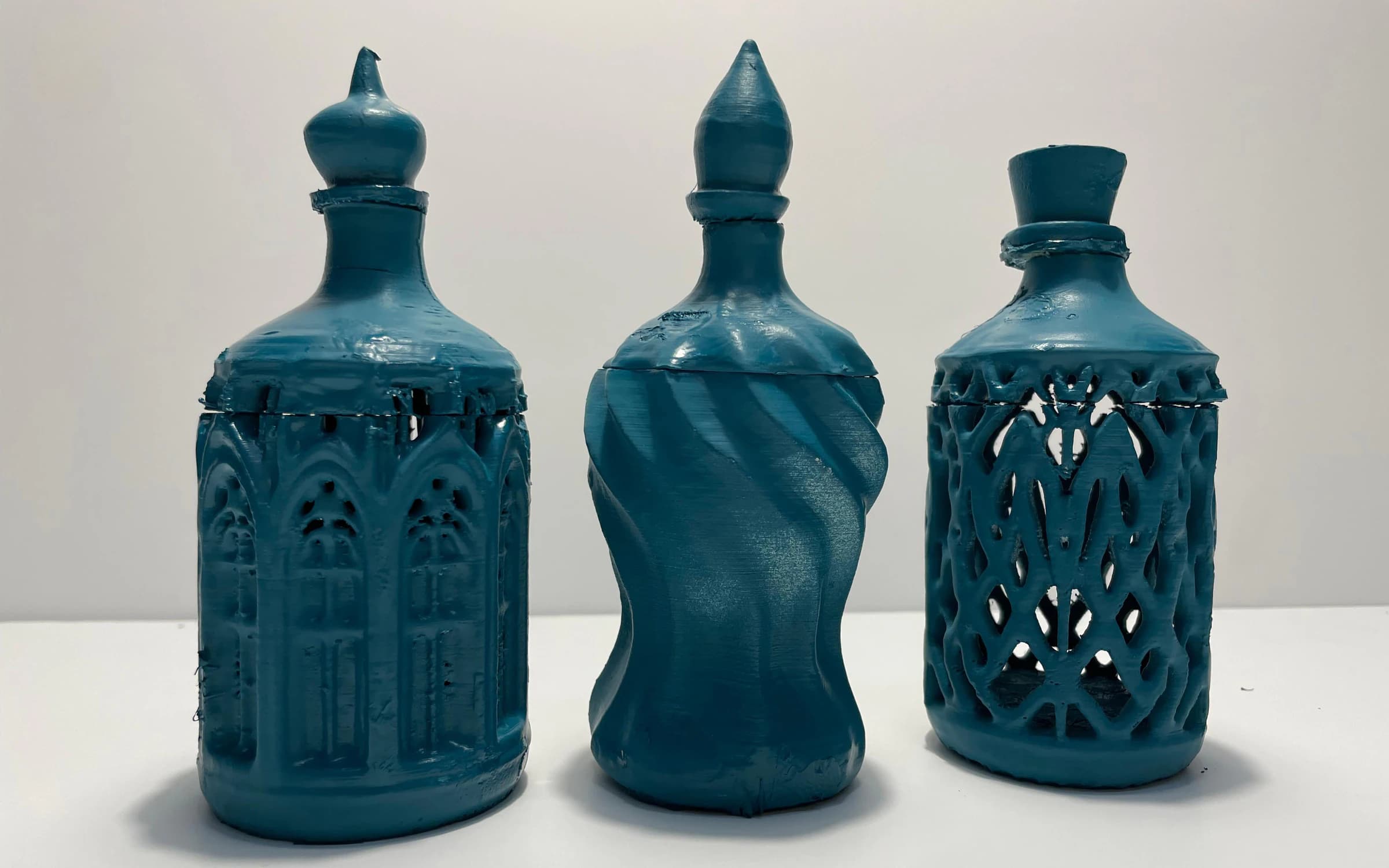
The story comes from Chaucer’s The Canterbury Tales, where pilgrims travel together to Canterbury Cathedral, each telling a tale tied to place, memory and the senses. I turned that into an edible journey through time, across three points: 100 years in the past, the present moment, and 100 years into the future. Each has its own bottle.
- 1The road to the old city: Canterbury 100 years ago, echoing the past and the ancient pilgrim road.
- 2The city as it breathes today: modern Canterbury, layered with old stones and new flavours.
- 3The future feast: a speculative Canterbury 100 years from now. Edible, playful, sustainable.
The ingredients come from the food culture of Chaucer’s time: red wine, apples, orange, cinnamon, honey, lemon, clove and olive oil. The past is recreated through historically grounded ingredients, the present through contemporary preparation, and the future through imagined combinations.
Cooking as design
I developed the recipe by hand. Apples were crushed and cooked, juices and spices combined, and honey, wine and water adjusted to balance sweetness, acidity and aroma. It evolved through tasting and smelling rather than fixed measurements, so cooking became a design process, with taste and smell as the materials.
The bottles took more experimenting. I pushed clay through a syringe to imitate clay 3D printing, but it was slow, dried too early and kept clogging. For an edible container, I heated honey and sugar into caramel and piped it into a glass-like mesh. The translucent, fragile forms fitted the idea. But the caramel hardened too fast to shape, broke easily, smelled burnt and stuck to the teeth.
Making it
I modelled the bottles in Blender, with the Beaney’s arches and a lattice mesh worked into their surfaces, then 3D printed and painted them. The lettering on the box was cut with a laser cutter.
The identity takes its lettering from the architectural lettering on the Beaney’s original plans, a style architects commonly used, which ties it to the building and its heritage.
- 1The letterforms come from the Beaney’s original plans, a typographic style commonly used by architects.
- 2The logo represents the three bottles: 100 years in the past, the present moment, and 100 years into the future.
Testing it
In sensory testing, one participant said the aroma immediately brought Canterbury to mind, and recognised the flavour as belonging to the place. They described distinct layers of flavour, then a crisp feeling as the liquid touched the tongue. Another used it purely as a perfume, and said the strong citrus heightened their senses. So taste and smell together could carry a sense of place, and the object worked in more than one way.
Scent has limits in a large room, though.
- 1The scent dispersed well near the source.
- 2It became increasingly faint towards the edges of the room, showing the spatial limits of how far smell can reach.
Where it went
Canterbury 100 was exhibited at the university. I also photographed it at the Beaney and at Canterbury Cathedral, the end of the pilgrims’ road.
What I’d change
It’s costly and slow to make. Edible bottles can’t be mass-produced, and food-safe materials add complexity. At a larger scale it would need glass or other stable containers, and edible parts have a short shelf life that needs controlled conditions and trained staff.
There’s room for it to grow, though: as part of guided tours, events and workshops, with local producers of honey, apples and spices, or as small tasting kits in the museum shop.